The graph, and how the mapping works.
The map is plain reading of your code. It draws the connections it can prove and says nothing about the ones it cannot.
What a scan actually does
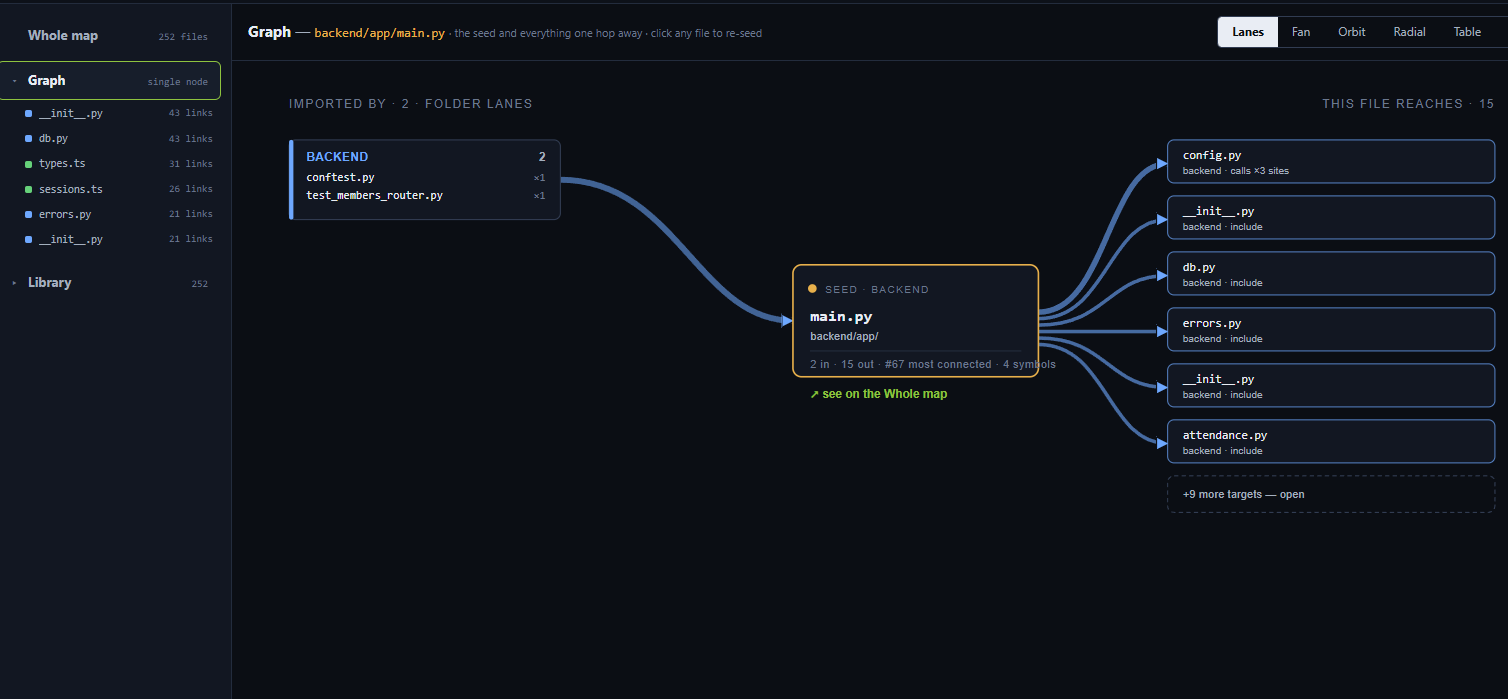
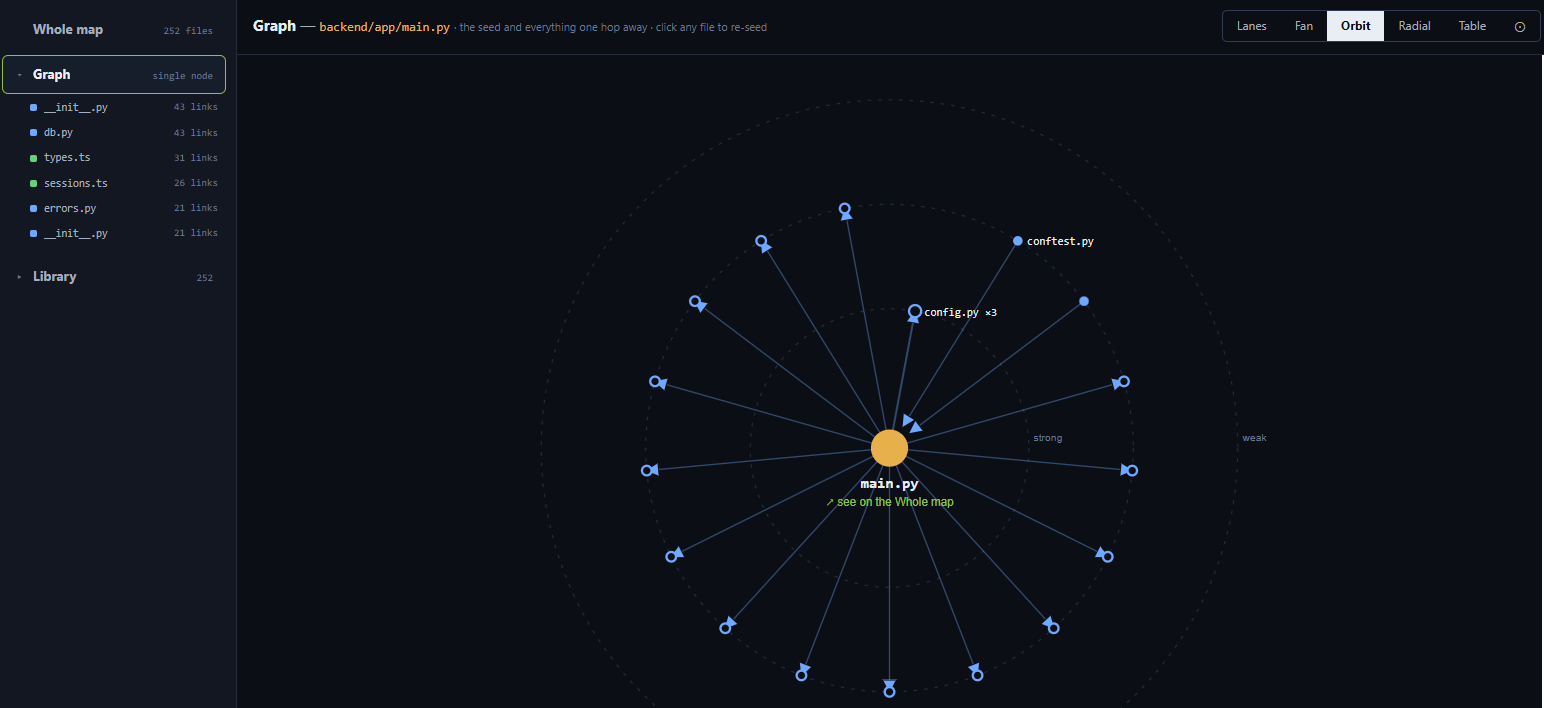
It parses each file, finds the things in it — modules, classes, functions, imports, calls, database tables — and records which file reaches which. Every line on the map is one of those resolved connections.
Two rules keep it honest. An edge is said once, not once per row, so a file that imports another ten times is one connection with a count, not ten lines of noise. And a file with nothing pointing at it says so plainly rather than being quietly hidden — the map reports "nothing the scan can prove points here", which is a fact about your code worth seeing.
No model runs during any of this. It is reading, not inference.
Five ways to look at one file
Pick a file and the graph will draw it five ways. They show the same resolved connections arranged for different questions. Lanes and Orbit are in the pictures at the top of this page, drawn from the same file so they compare. The other three:
Fan
Follows one direction outward, for tracing where a change would travel.
Radial
Arranges by depth, for seeing how far the reach actually goes.
Table
The same connections as rows you can read and sort — the view that shows the map is data, not decoration.
The whole map
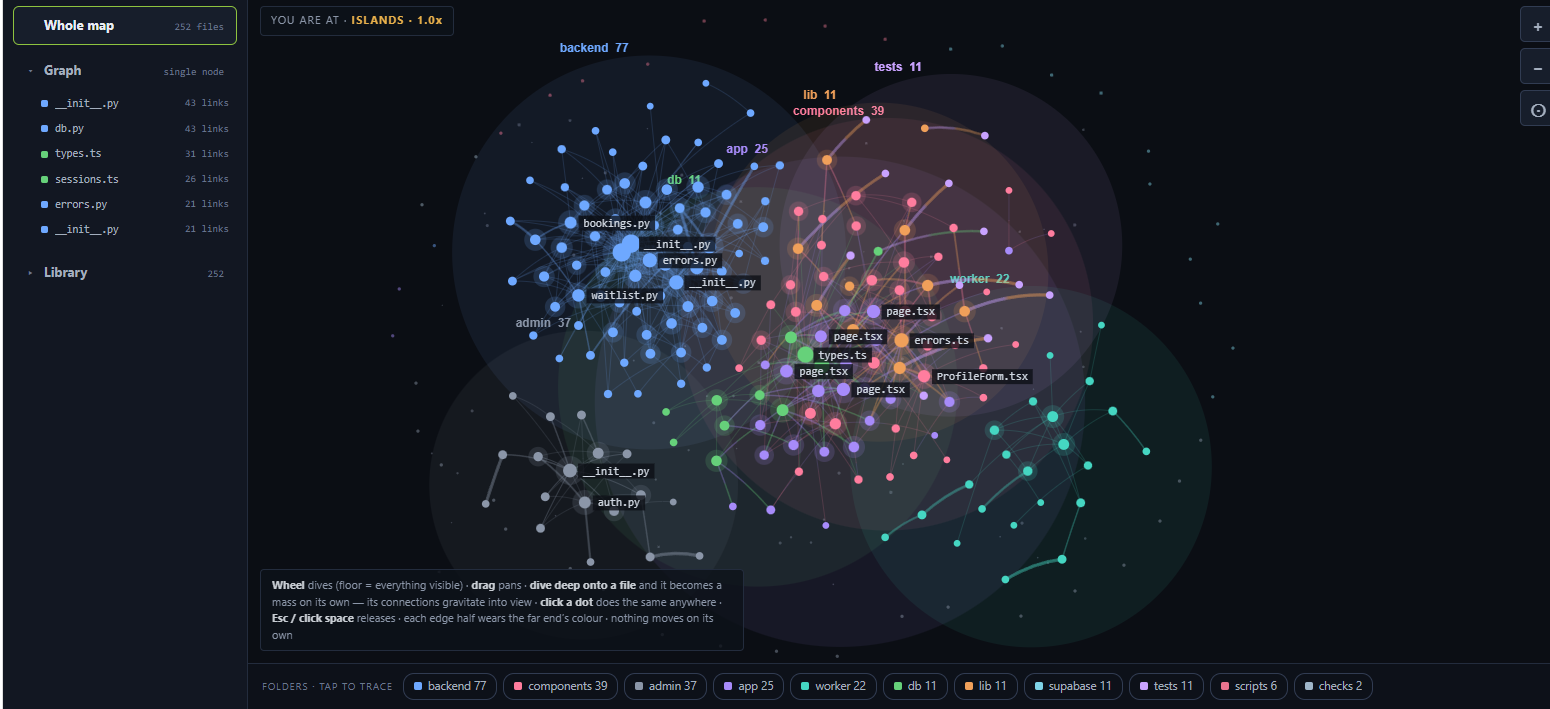
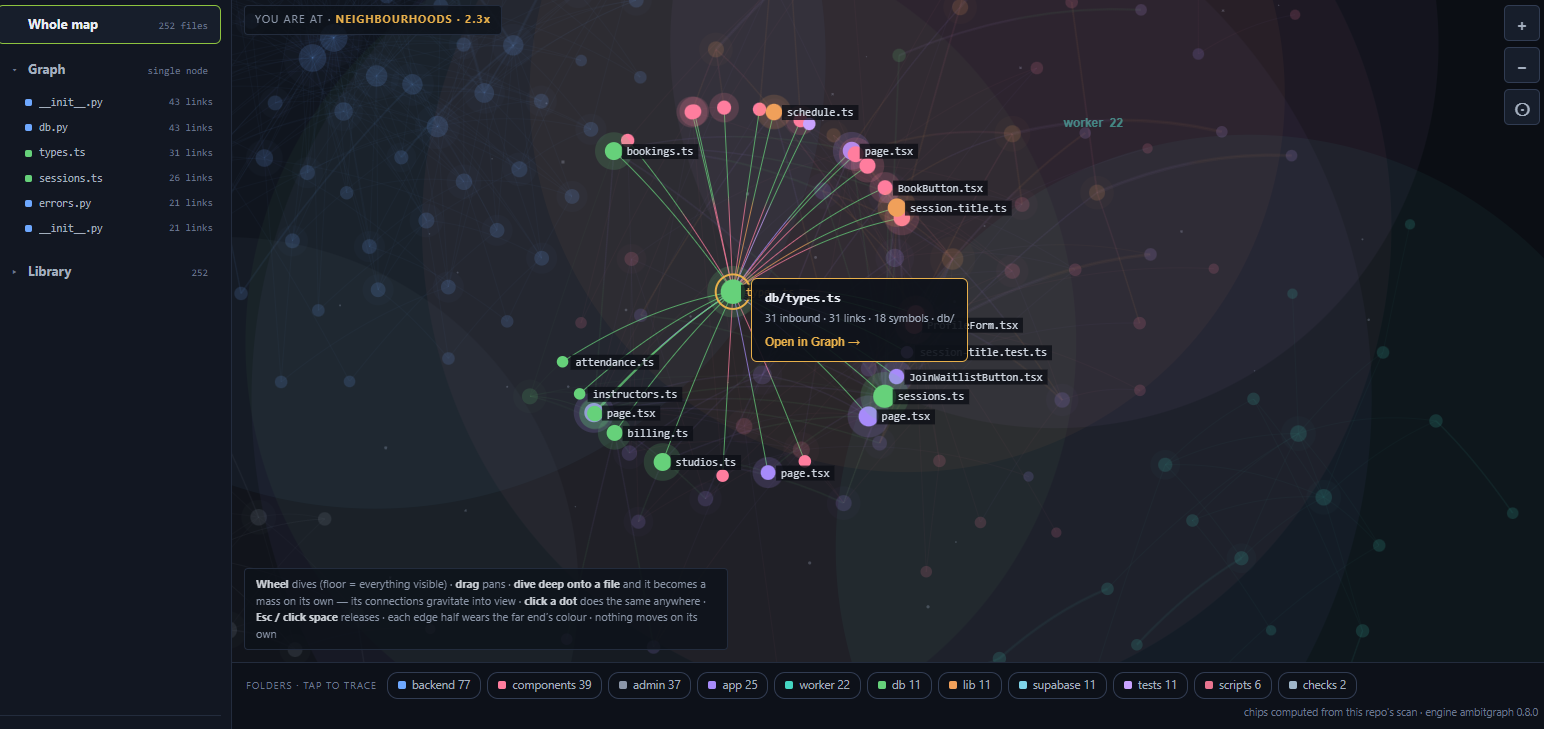
Beyond one file there is the whole repository at once. Folders become coloured regions; files become dots sized by how connected they are. Zoom in and it resolves — regions become neighbourhoods, neighbourhoods become named files.
How far each language is read
Not every language is read to the same depth, and the map does not pretend otherwise.
Read in full
Python, JavaScript, TypeScript, Java, JSP, Ruby, C, C++, Swift and Go. The scan reads the grammar and resolves imports, includes and calls between files.
Read at connection level
SQL and shell are read for what they connect to — the tables and the files they reach — rather than parsed as full grammars.
Frameworks it knows by name
FastAPI, Flask, Next.js and Express for your routes, and Supabase for your tables. Knowing the framework means the map can tell a route from an ordinary function.
When a language is not covered
The same map, with the languages the plain reader does not parse handled by your own assistant instead. Your subscription, your model, your machine. It opens the same way and stops the same way.